Overview
Shooting projects on a budget can mean limitations on your gear. So how can you maintain a “cinematic” look without a cube truck full of lighting equipment? And finding a video lighting kit for an upcoming film can be a daunting task. There are many different kinds of lights you can use, and each has its own strengths and weaknesses. But understanding the different forms of film and videography lighting gives you a solid start. Learning their various strengths and weaknesses in different environments will get you more comfortable with which specific lights to choose for your own film lighting kit.
For today’s post we looked to great minds in the field, and professional cinematographers as well, to shine a light on the types of film and video lighting kits you need to know about.
The first step to painting cinematic pictures with light is knowing the types of light. Then you can pick-and-choose what’s best for your own production lighting choices.
Prepare to be inspired!
Fluorescent lights
If you’ve ever spotted a lighting fixture on set with a row of light tubes, then you’ve seen fluorescent film or video lighting kits at work. These lights emit ultraviolet light from mercury vapour and can be balanced for both indoor and outdoor use.
A fluorescent lamp uses the excitement of low-pressure mercury vapour to produce ultra-violet light, in turn causing a phosphor coating on the inside of the glass tube to glow giving off light in the visible spectrum.
Fluorescent light is much more efficient than incandescent light and is capable of generating up to 100 lumens per watt, similar to the output of HMI.
The spectrum of light emitted is different from an incandescent source and depends on the mix of phosphors used. However, a CRI up to 99 can be achieved. The colour temperature of a fluorescent can vary also from 2700K to 6500K depending on the phosphor mix.

Uses
Fluorescent film lighting is most often used in fixtures containing banks of tubes. These tubes are normally either tungsten or daylight colour balanced, or the tubes can be mixed within the fixture to vary the overall colour mix of the light. They produce a soft and even light and can be used in relatively close proximity to the subject. Fluorescent lighting is often used to light interiors and has the advantage of being more compact and cooler in operation than tungsten or HMI lighting.
Advantages
Fluorescent lights offer a naturally soft light that is common in everyday interiors. And they are also affordable, easily transported, and adaptable to different shooting environments. Like LEDs, the fluorescent film lighting kits have modest power requirements and don’t get too hot while running.
High efficiency
Low power requirement
Low cost
Long lamp life
Cool
Capable of soft even lighting over a large area
Lightweight
LED Lights
The LED video light is all the rage for ultra-low-budget shoots. Although their portability lends themselves to micro-budget filmmaking, there are higher-end fresnels that are growing in popularity as well.
LED’s are by nature monochromatic, producing only a single wavelength of light. So the challenge of LED lighting has been in creating a full-spectrum white light. This can be done in two ways, either by combining the light of red, green and blue-emitting LED’s or with white LED’s whereby the visible white light is created by phosphors that are excited by an ultra-violet emitting LED.
LED lights can be daylight or tungsten balanced, sometimes switchable or having variable colour temperature. Some have variable colour through the entire RGB spectrum, which is something not possible with any other lighting technology. The CRI rating of LED lighting can be over 90.

Uses
LED’s are becoming more and more common on film sets. They can easily be battery powered making them very portable and requiring no separate ballasts or heavy cabling. Panels made from LED lights can be small and compact, or large for a variety of situations.
LED’s are also powering more traditional Fresnel style lamp heads such as the Arri L-series. Overall power outputs are on the rise, which is good news.
Advantages
Soft, even lighting
Pure light without UV-artifacts
High efficiency
Low power consumption, can be battery powered
Excellent dimming by means of pulse width modulation control
Long lifespan & No risk of explosion
Environmentally friendly
Insensitive to shock
HMI lights
An HMI is a powerhouse arc lamp lighting source that is crucial for lighting outdoors (or replicating outdoor light shining into interiors). Because they are so powerful, they are also a good resource for lighting large sets.

PROS
As mentioned above, the sheer brightness of an HMI makes it a necessity for strong light sources. They aren’t the power hogs that tungstens are, and don’t create as much heat on set.
CONS
HMI lights are highly expensive, so you must have a budget that allows for them.
These require more set-up and take-down than other forms of lighting, simply because each HMI requires an attached ballast that regulates the arc lamp.
There are also additional power and safety considerations to make when using an HMI. They often require generators and personnel to operate them.
Luminous Efficiency Compared
Tungsten Quartz Halogen: Up to +/- 35lm/W
HMI: Up to +/- 115lm/W
Fluorescent: Up to +/- 100lm/W
LED: Up to +/- 150lm/W
LIGHTING TECHNIQUES
1. Basic lighting: the three-point lighting setup
The most basic lighting in the film is the three-point lighting setup. Lighting from three directions shapes your subject and sets them apart from their background.

Film lighting basics: Amelie (2001), shows cinematographer Bruno Delbonnel using the three-point lighting setup
To achieve this, your film lighting equipment needs to face your subject from three directions: front, back and side (generally).
KEY LIGHTThe key light is the light that registers most prominently in your frame. So, when you look at the image of Amelie above, you’ll see that the screen-right portion of her face is brightest. That’s the key light.
FILL LIGHTSQuite simply, fill lights fill in the shadows of your frame. You’ll notice that the screen-left portion of Amelie’s face is in shadow, but with her features still plainly visible. That is a fill light at work.
BACKLIGHTThe backlight gives an edge light to the rear portion of your subject. Often, the backlight shoots down from a higher angle. You can see that Amelie has a light contour along her shoulders and the nape of her neck.
You’ll generally want to flank your camera with your key and fill lights, spaced about 60 degrees on an axis from your camera.

Basic lighting techniques: Back, Key, and Fill lighting arranged around a camera.
2. Soft film lighting
When talking about how a scene should feel emotionally, one thing that is referenced by cinematographers frequently is how hard or soft the lighting should be.
The hardness or softness of light concerns how large a light source is, and how it affects shadows on your subject.

Soft film lighting in a day exterior from Harris Savides’ cinematography in Restless
HIGHER KEY LIGHT
This is an effect created by heightening the key light and using fill lights generously. This keeps the lighting bright and balanced in your frame, creating almost no shadow. This balances the lighting from object to object in your frame -- which is known as your lighting ratio.

You can soften a light source with diffusion materials like gels or Chinese lanterns to reduce shadows. This is great for conversation close-ups.

3. Hard film lighting
Conversely, smaller light sources, including bright sunlight, will heighten the shadows on your subject. Conservatively, this should be avoided. But it can also create dramatic effects, as was popularized in the classic film noirs, which featured suspicious and volatile characters.
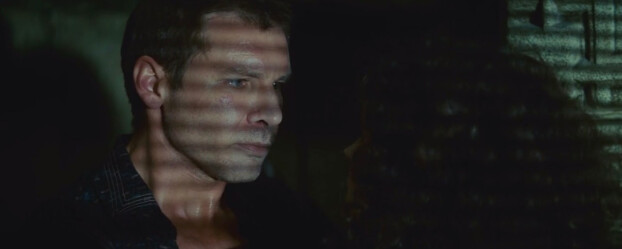
Hard lighting creates harsh shadows in Blade Runner's film lighting.
KICKER LIGHT WITH SOFT FILL
In this effect, the backlight hits the side of your subject’s face. It can create an angelic rim of light, while a very soft fill light keeps the face gently illuminated.
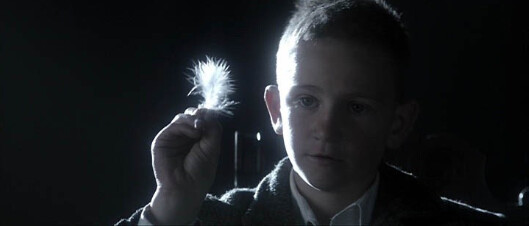
An angel-to-be receives an angelic kicker light in Northfork. Cinematography by M. David Mullen
LOW KEY LIGHT
Low key lighting refers to minimizing or eliminating, the fill light your shot so that it is intentionally shadowy. This can create dramatic, suspicious, or even scary effects.

Among the types of lighting in film, low key lighting is great for extracting mystery from the shot.
4. Motivated lighting
When cinematographers light a set, they always ask themselves where, within the scene, the light comes from.
They might, for example, choose to take the practical lights that are already in a location and elevate their effect. This is motivated lighting.
Oscar-winning cinematographer Roger Deakins is known for the motivated lighting choices. Consider this shot from his work on The Assassination of Jesse James by the Coward Robert Ford:

As you can see, the lighting in this scene is motivated by the lanterns carried by the actors. When motivated lighting is done right, the audience is unaware of the artifice at work.

Lanterns create motivated light sources that sell the lighting choices in The Assassination of Jesse James.
PRACTICAL SET LIGHTING

A practical overhead bulb lights the subjects in this wide shot from The Quiet, cinematography by M. David Mullen
Often, using existing lamps and light sockets around the set can be used to light a scene. This is referred to as practical lighting and is particularly useful when you need to reveal wide portions of the set or move around it in longer takes.
This was the case in the diner scene in Moonlight. In an interview for TIFF Originals, DP James Laxton spoke about how he used practical set lighting to keep his location visible in wide frames.
In essence, he swapped out the bulbs in the existing light sources around the diner to make them stronger. Since the scene reveals wide portions of their location, he relied on the practical sources, with some of the LED light mattes brought in as well for additional soft, balanced light.

5. Natural film lighting
Natural film lighting refers to using and modifying the light that is already available to you at your location.
Before you shoot, you can take your camera to the location to see how well the natural light holds up. You can decide from there how what additional lights you might need, or how you might adjust the light. For example, you can use bounce boards for reflecting the light, or black flags for blocking it out.
Cinematographer Emmanuel Lubezki maximized natural film lighting on Alejandro Inarritu’s The Revenant. His interview with GoldDerby is a wonderful primer on finding and controlling available light in outdoor shooting locations.

Emmanuel Lubezki’s Oscar-winning cinematography in The Revenant created beautiful imagery with natural film lighting.
For example, he speaks about using Magic Hour, or the soft light created by the sun at the end of the day, for specific moments. And, further, he talks about how the selection of locations, and how they appear at different times of the day, created appropriate moods for the shoot.
It required a great deal of flexibility and preparation, but the results are stunning.
6. The set lighting technician's handbook and other good reads
SET LIGHTING TECHNICIAN'S HANDBOOK: FILM LIGHTING EQUIPMENT, PRACTICE, AND ELECTRICAL DISTRIBUTION
SIGHT, SOUND, MOTION: APPLIED MEDIA AESTHETICS
THE BARE BONES CAMERA COURSE FOR FILM AND VIDEO
THE LITTLE BLACK BOOK OF LIGHTING FOR FILM AND VIDEO